
Broken Pressure Regulator
The propane goes out in the middle of an arctic blast... reminding me of the pressure on our nervous systems we've all been experiencing

Do you ever feel like you’re getting the chance to relive moments when you got caught off guard, sideswiped, knocked off balance? Times when you were hypnotized, not mesmerized. Maybe you should have seen it coming, or maybe your nervous system just went into five-alarm fire mode and you overreacted? Or maybe you dealt with the unexpected circumstance but still got blasted with a huge cortisol dump / fight-or-flight adrenaline surge that left you dealing with the physiological consequences for far longer than the situation itself merited. (At least with the benefit of hindsight…)
Today felt like one of those days. As my long-time readers know, the winters out here on the mountain have brought some dire moments. Nights shivering in bed with several layers of clothing, under all the blankets in the house plus a sleeping bag for each of us. Days without water waiting for the temps to get and stay above freezing long enough for the pipes to thaw out. Chopping wood in the morning and chopping wood in the evening, just trying to keep the little wood stove fed enough to keep us all from freezing. Being so cold and so tired that doing anything more than surviving feels improbable.
We’ve only had to deal with three or four of those survival-level storms since we moved up here two years ago. And we have, obviously, survived.
We’ve also been consistently investing in things that should make this coming winter a little less dreadful: wool blankets, building a bed frame to get the bed up off the floor (in this poorly-insulated cabin, the indoor temperature drops dramatically over each vertical foot downward from the ceiling), heat tape to thaw the pipes quicker, and so on.
Late this summer, we bought a new propane heater to replace the one we inherited. I mean, a lot of this stuff you just don’t know until you’re living in an off-grid situation. Tatiana was researching cute wood stoves online (the wood stove we inherited works but it’s very temperamental and not a very efficient heater considering the size it takes up) when she stumbled across reviews of the propane heater that came with the cabin. The reviews tilted heavily towards the I’d give it zero stars if I could end of the spectrum.
“Everyone says this heater is terrible,” she told me. “It’s incredibly inefficient; basically, half the heat goes outdoors through the vent in the wall. I wonder if we got one of the medium-size Mister Heater models, if it might actually heat the cabin. We wouldn’t have to spend all of our time in the winter chopping wood and trying to keep the wood stove going.”
“I don’t know, but it seems worth a try,” I said.
A couple weeks later we saw that they had one of the 18,000 BTU Mister Heater units at the Mennonite lumberyard. We bought it and I installed it in September. This thing is freaking amazing! Even on the low setting, it just blasts. In fact, it hasn’t been cold enough yet this fall to leave it on overnight because it puts out so much heat.
So, we were feeling pretty confident about being as prepared as we could afford to be1 for winter, with at least another six weeks to refine our systems and shore up our known weak points.
And then —
Mercury Retrograde and Freakish Early Season Cold
Please allow me to give another shout-out to Fred, our previously-much-maligned but now squarely-in-the-picture for off-grid appliance MVP. For those of you just tuning in, Fred is our 4,000-watt Harbor Freight gas generator, the workhorse of our off-grid power system. It took me a year of Fred ownership, one under-warranty exchange, and one post-warranty attempt at exchange to understand Fred’s strengths and weaknesses and figure out how to keep him maintained.
It turns out that Fred can only go a few months at the most without snapping one of his throttle springs. He seems to need a full carburetor replacement annually. But we run him every day and in some pretty harsh temperature extremes that he wasn’t really designed to endure.
Fortunately, you can get a four-pack of replacement springs on Amazon for about $10. I’ve now spent enough time working on Fred’s carburetor to be able to replace one of the throttle springs in about 30-40 minutes. And Fred lets me know when one of them needs replacing by causing the lights in the cabin to start strobing like a scene from a horror movie.
Dear Fred. I take back all of the mean things I said about ya. I didn’t know ye well, son. I thought ye was just malingerin’ when in fact ye needed a little love and care to show yer mettle and prove yerself a worthy member of the crew.
Knowing that Mercury was stationing retrograde on Sunday (yesterday) and then watching the weather forecast suddenly shift from sunny days with highs in the 50s and lows in the 30s to today’s forecast of highs and lows in the 20s with wind chills hovering around 13 degrees, I figured we might be in for a stress test on some of our power and water systems.
I was just hoping that a bunch of stuff wouldn’t fail in the middle of the night when it was so cold all we wanted to do was stay inside and wait out the storm.
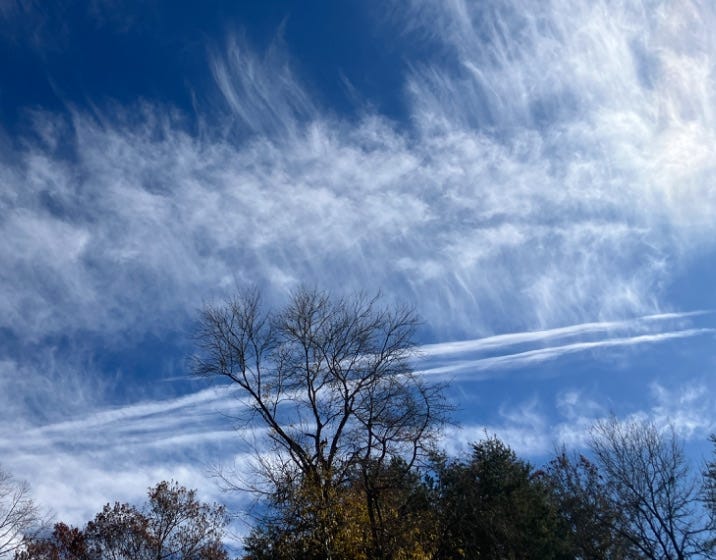
Fred didn’t let me down. The lights started flickering right before I shut him down for the night on Wednesday. The weather had been delightfully temperate despite the chemtrail flights steadily increasing overhead. Beginning to blot out the sun as the powers that be prepared the atmosphere for the major thunderstorms planned for Friday and the stratospheric temperature drop forecast for the weekend) —
After I turned off the power switch and shut off the gas, I shined my flashlight in to where the throttle springs are and, sure enough, the smaller one had snapped off right above the spring part.
So, Thursday morning after lunch I went out and replaced the broken spring. Fred was good to go. Now if the propane supply held up…
I knew our 100-pound propane tank was running low. But we had a few 20-pounders ready to go. I figured we’d be OK as long as the big tank didn’t run out in the middle of the night on Sunday when it was going to be 20 degrees and howling winds.
For those of you who have never lived with propane appliances (I hadn’t before moving here), propane gas is odorless. But they add an odor to it that only (usually) becomes obvious when the propane tank is running low. Or if there’s a leak in the system. This is a great safety feature, because it keeps you from accidentally blowing yourself to kingdom come. And the smell lets you know when you need to switch over to a new “bottle” — as they call it at our favorite local propane retailer.
I knew the bottle was getting close to empty last night by the increasing rotten egg odor emanating from the kitchen stove, but sometimes you’ve got two or three days when you start noticing the smell until the tank is really empty. It wasn’t too bad, and seemed confined to the area right next to the stove, so we decided to just go to bed.
Mister Heater was blasting. The temperature in the cabin was shockingly cozy considering how cold it was outside and how hard the wind was blowing.
I woke up at 2 a.m. to hear Tatiana fussing with the heater.
“I turned it off because it got too hot in here,” she said. “Now I can’t seem to get it lit. The pilot light is on, but every time I turn it to ‘low’ the pilot light flickers out. Am I lighting it wrong?”
I’m a deep sleeper and it can take me a while to access my rational mind when I’m awakened in the middle of the night. But I knew instantly what was going on. The rotten egg smell had gotten worse in the kitchen/living room part of the cabin — really, one room, but it feels bigger if I think of them as two separate areas.
“The tank is empty,” I announced in a guttural, Johnny Cash baritone. “Must change out the tank.”
I put on a sweatshirt, coat, scarf and hat, pulled a headlamp on over my hat, and went out to the toolbox on the porch. Grabbed the channel lock pliers out of the toolbox. Turned off the gas on the 100-pound cylinder, unscrewed the pressure regulator from the top of the tank, moved a 20-pound tank into position, and screwed the pressure regulator onto it.
The flare fitting on the pressure regulator did something weird as I was screwing it on. It moved in a way it hadn’t ever moved before. But it was cold, I was in middle-of-the-night zombie mode, and I know nothing about pressure regulators. So I hoped it was an anomaly and headed back inside. I lit the pilot light on Mister Heater, lit the pilot light under the kitchen stove, and we went back to bed.
In my midnight haze, I was feeling pretty good about knowing what to do and getting it done in short order.
I guess it was around six in the morning when I woke up again. The cabin was cold. Tatiana was trying to boil water on the stove for coffee. I sensed something was wrong.
“What’s going on, baby?”
“I’m trying to make coffee but the fire on the burners is tiny. And the pilot light has gone out in the oven.”
I struggled into full waking-ness.
“Maybe the 20-pound tank I put on last night was mostly empty,” I said. “I’ll go try another one.”
I did it. Came back in. Nothing.
“I think the regulator is fried,” I said. “It did something weird last night that it’s never done before. We’ll have to get another one.”
Tatiana got her winter gear on and went back to the old shop where we store some of our seasonal gear and other stuff we don’t have room for in the cabin, and returned with our portable camp stove. While she made coffee, I got a fire going in the wood stove with some pieces of oak that had been sitting high and dry in the cradle next to the stove since last winter. It was the easiest fire I ever lit in that curmudgeonly old stove.
Pretty soon we were reasonably warm and enjoying a nice hot cup of coffee.
“I get that it’s the pressure regulator,” I said. “What do you get?”
She did her tuning in thing and agreed that a new regulator seemed to be the fix we needed.
“I guess we could go to the feed store and see if we can get the big tank filled,” I said. My boss had told me earlier in the week that the Mennonites were now offering propane refills. But it wasn’t really clear if they were doing it for the general public or only for members of the community. (My boss has lived here since before the Mennos moved up on the mountain and is sort of an unofficial member of the community.)
“I know the guy at Wildwood Enterprises has propane stuff. It’s right on the way to the feed store.”
“We could just drive in to Sparta and fill the tank at Spar Gas,” my baby said.
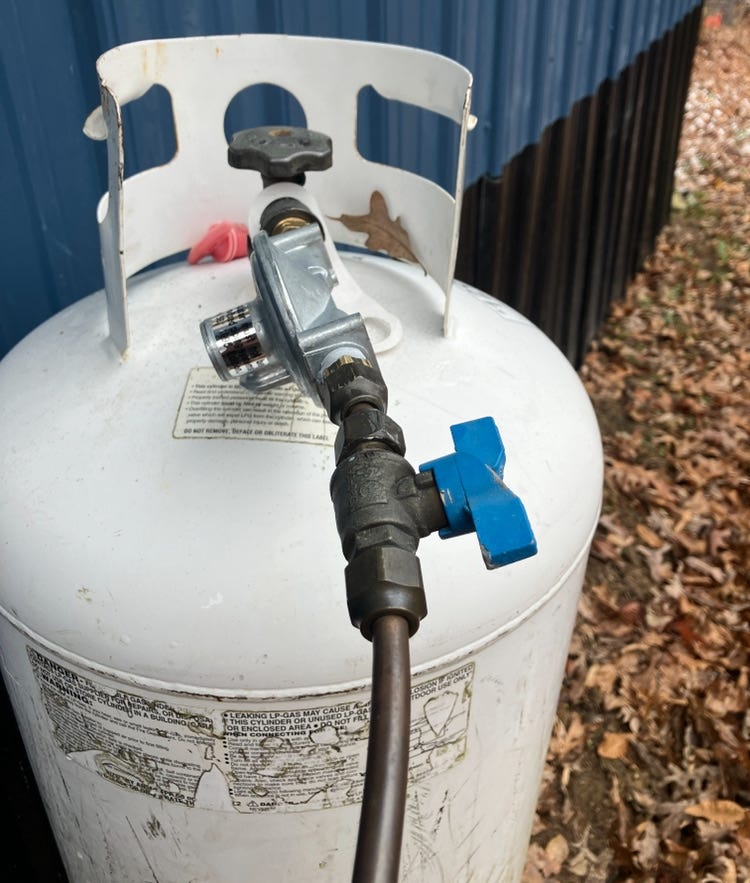
“Oh yeah! I’ll bet they’ve got a regulator that would work.” I had been looking up propane regulators on my phone. It seemed like the one we’d inherited with the cabin was both way bigger and more complicated than we needed for our little system, and also ancient and no longer being manufactured.
I removed the old regulator from the copper line and we took it with us to Spar Gas. The lady behind the desk showed us a much simpler-looking regulator and assured us that was the one we needed.
I showed her the broken one and asked if we didn’t need one like that — a two-stage regulator.
She looked at me as if an extra head had just popped out of my shoulder.
“You got one bottle, right?”
“Yes ma’am.”
“This is all you need.”
It cost $14. We drove home, I hooked up the new regulator to the line, screwed it onto the full 100-pound bottle. Went inside, hoping that was the remedy we needed.
Fired up Mister Heater. Perfect. Lit the pilot light on the kitchen stove. Bam. Checked to see if we had hot water again. Boom.
And we stayed toasty for the rest of the day. Except for the time I had to go out in the snow because Kobi loves chasing snow. And the time we had to take him for a walk in the woods. Because his doggie sense of routine demands his evening walk, even if he’s so cold he can barely stand to stay outside.
So, it was a bit of a stressful weather event. But it should be over by tomorrow morning. And as of this writing, it’s delightfully warm in the cabin. We even still have running water. (And plenty of bottled water if the pipes do freeze overnight.)
Retrograde Mercury did his job and showed us what needed to be upgraded before it gets cold and stays cold this winter. And we did our jobs and stayed as calm as possible and followed our inner guidance. Which doesn’t always guarantee a quick fix — sometimes life is complicated — but it worked out as gracefully as possible today.
We both felt a little whacked by the time we got everything working again. It got me thinking about regulating pressure. Which is an important component in water and other liquid energy systems, including propane gas.
I’ve been thinking about how our bodies are systems that run on liquid energy. Water, blood, lymph.
And thinking about how we’ve all been subject to some intense dis-regulation in the last five years. And most of us have been dealing with a lifetime of dis-regulation due to childhood trauma and the ever-increasing (until now) barrage of new technologies, environmental toxins, electrical pollution, radiation bombardment, and so much more.
We may not be able to stop all of that from hitting us. But we can acknowledge that it’s happening, and that it has happened, and we can take extra care of ourselves and our beautiful and resilient nervous systems as we head into the holiday season.
Sometimes the most important thing we need to do is not the thing the Matrix-monkey-mind is telling us is important. Sometimes the most important thing, the most valuable thing, is to slow down, take naps, meditate. Go for walks, listen to birdsongs, play some music. Disconnect from our phones and from social media and just take it easy. Make a point of taking time and space to be quiet.
Our bodies can heal so quickly and so well when we give them what they need. Recognizing what our nervous systems — and our hearts and souls — have endured and allowing ourselves to be aware of the need to be gentle with ourselves isn’t as sexy as the ever-cycling “wellness fads” like cold plunges, ayahuasca ceremonies, or the latest extreme diet. But it’s powerful medicine that aligns with our mammalian nature.
We have considered removing all of the metal siding and adding plywood sheathing and extra or better insulation. And then maybe replacing the metal siding with T-111 or some other wood siding. It would make the cabin much cozier in the winter and less like a furnace in the summer. But that’s a major renovation to a place we don’t own and might not inhabit for more than another year or so. Not only would it cost more than we care to spend right now, it would also require a significant investment of time, energy and attention…
it’s a little out of our (economic and time + energy) budget this year.